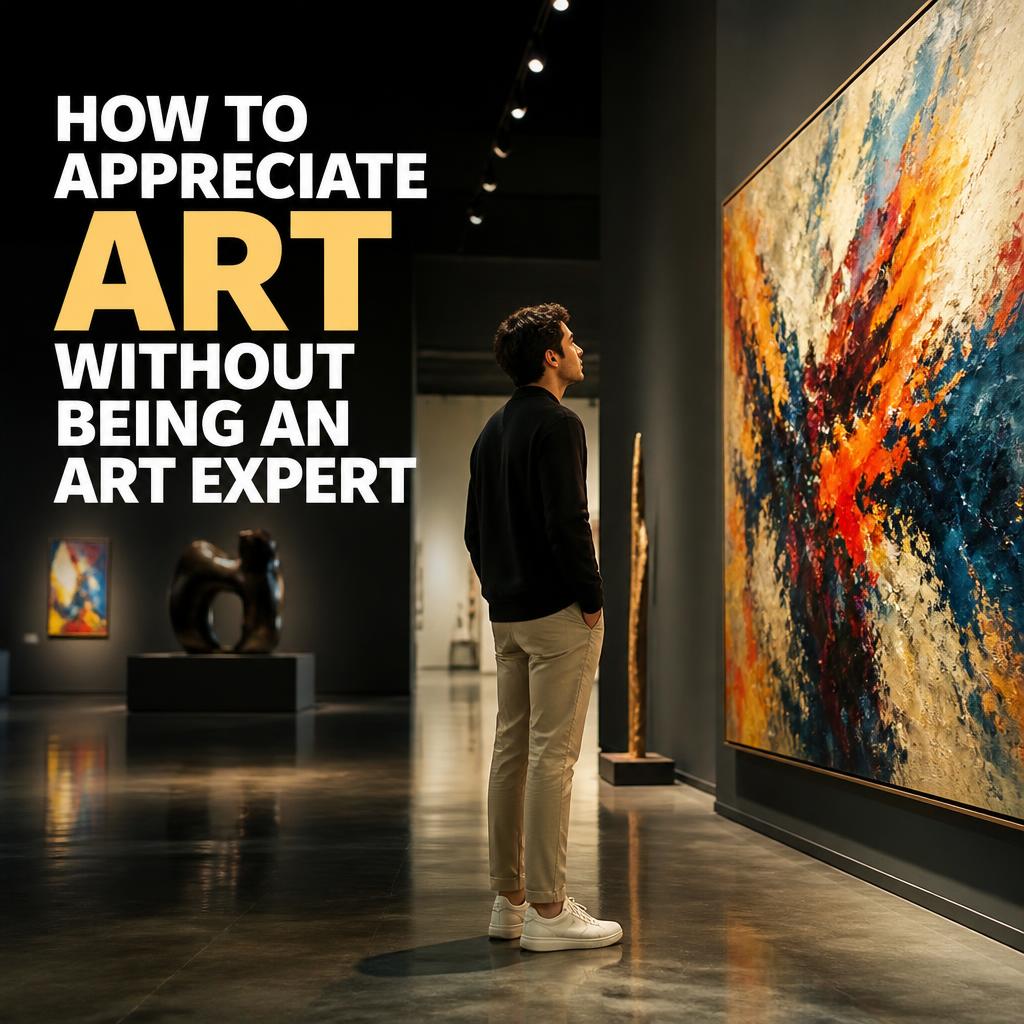
How to Appreciate Art Without Being an Art Expert starts with one simple idea: you do not need a degree in art history, a sophisticated vocabulary, or years of gallery experience to enjoy what you see. Art appreciation is less about knowing the “correct” answer and more about paying attention, staying curious, and noticing how a piece makes you think or feel.
Whether you are standing inside a famous museum, visiting a small local gallery, scrolling through digital artwork, or looking at a mural on the street, you already have everything you need to begin. Your eyes, emotions, memories, and curiosity can turn an ordinary viewing experience into something surprisingly meaningful. – artitudesgallery.com
What Does It Really Mean to Appreciate Art?
To appreciate art means giving a work enough attention to discover what it communicates to you. That does not necessarily mean liking it. In fact, some memorable artworks can feel strange, uncomfortable, confusing, or even frustrating at first.
Appreciation involves asking what you notice, why certain details attract you, and how the artist may have created a particular mood. You can enjoy the visual experience while gradually learning about composition, symbolism, technique, and cultural context.
In other words, appreciation is not an exam. Nobody is waiting nearby with a red pen.
Start With What You See, Not What You Think You Should Know
When people feel intimidated by art, they often immediately search for the artist’s name, movement, date, or hidden meaning. Try doing the opposite.
Spend a little time simply looking.
Notice the colors, shapes, textures, figures, empty spaces, and overall arrangement. Is your eye immediately drawn toward one particular area? Does the work feel balanced or chaotic? Bright or gloomy? Calm or energetic?
This first impression matters because it captures your response before outside information begins influencing your interpretation.
Give the Artwork More Than a Few Seconds
We are used to scrolling quickly through images, so slowing down can feel surprisingly difficult. Still, giving a painting, sculpture, photograph, or installation an extra minute can reveal details that were invisible during the first glance.
You may suddenly notice a tiny figure in the background, an unusual shadow, repeated geometric forms, or a facial expression that changes the entire mood.
Ask Simple Questions Instead of Searching for the “Right” Answer
You do not need complicated questions to understand visual art. Start with the basics: What is happening? Who or what attracts my attention? Where does my eye travel? When might this scene take place? Why might the artist have made these choices? How does the work create its mood?
These familiar what, who, where, when, why, and how questions provide a natural framework for exploring almost any artwork.
What Is the Artwork Making You Feel?
Your emotional reaction can be an excellent entry point. Perhaps a painting makes you nostalgic without knowing why. Maybe an abstract work feels energetic, while a photograph creates tension.
There is no requirement to experience the emotion that somebody else describes in a museum guide.
Your reaction is personal, and that is part of the fun.
Pay Attention to Unexpected Reactions
Sometimes the most interesting response is confusion.
If you catch yourself thinking, “Why would anyone make this?” stay with that question for a moment. Confusion often means the artwork has interrupted your expectations, which can make it worth exploring further.
Learn a Few Art Terms Without Turning It Into Homework
Knowing a handful of terms can make looking at art easier. For example, composition describes how visual elements are arranged, while perspective relates to how depth and spatial relationships appear.
You may also encounter chiaroscuro, an Italian term associated with dramatic contrasts between light and dark. Meanwhile, impasto describes thick applications of paint that create visible texture.
These words are useful tools, not membership requirements.
Notice Color, Light, Texture, and Space
Color can establish mood before you understand the subject. Warm shades may create energy or intimacy, while cooler tones can produce distance, calmness, or melancholy.
Light also guides attention. Artists may illuminate a face while leaving the background dark, encouraging viewers to focus on one emotional moment.
Texture works differently. A smooth surface can feel controlled, whereas rough brushwork may create movement and physical intensity.
Look at How the Artwork Was Made
Once you have explored what you see, consider how the artist produced it.
A painter might use tiny controlled strokes, while another works with broad, visible marks. A sculptor may choose polished marble, recycled metal, wood, clay, or unconventional materials. Photographers make decisions involving framing, exposure, timing, and perspective.
Technique can reveal personality.
Materials Can Change the Meaning
Imagine the same human figure created from marble and then recreated from discarded plastic bottles. Although the shape might remain similar, the material completely changes the conversation.
This is especially noticeable in contemporary art, where artists frequently use everyday objects, digital media, sound, video, and temporary installations.
Materials are not merely technical choices. Sometimes they are part of the message itself.
Discover the Story Behind the Artist
After forming your own impression, learning about the creator can add another layer.
Who created the work? Where did the artist live? When was it produced? What political, social, cultural, or personal events surrounded its creation?
Historical context can transform something that initially looks simple into a much richer experience.
Context Helps Without Controlling Your Opinion
Background information should expand your understanding rather than dictate your reaction.
For example, discovering that an artwork emerged during war, migration, industrial change, or social upheaval may explain its imagery. However, you can still respond differently from critics or historians.
Knowledge gives you another lens. It does not replace your own eyes.
Stop Worrying About Whether You “Get” Abstract Art
Abstract art probably causes more nervous gallery conversations than almost anything else.
People often stare at an abstract painting and wonder what it is supposed to represent. Sometimes that question is unnecessary.
Instead, examine rhythm, movement, contrast, color relationships, scale, and visual tension. Think about music: you can enjoy an instrumental piece without asking what physical object every note represents.
Abstract artwork can work in a similar way.
Try Experiencing Before Interpreting
Stand at different distances. Look at the whole piece, then move closer to examine the surface.
Ask whether the work feels fast, slow, heavy, playful, aggressive, peaceful, or unpredictable.
That experience itself can be valuable, even if you never create a neat explanation.
Compare Different Artworks to Develop Your Taste
One of the easiest ways to understand your preferences is comparison.
Perhaps you enjoy realistic portraits but feel less connected to minimalist sculpture. Maybe bold modern paintings capture your attention more than classical landscapes.
Instead of simply saying, “I like this one,” ask yourself why.
Over time, patterns emerge. You might discover that you consistently respond to dramatic lighting, surreal imagery, expressive brushwork, architectural photography, or vibrant color combinations.
Visit Museums and Galleries Without Trying to See Everything
A common mistake is attempting to inspect every object in a museum.
That quickly becomes exhausting.
Choose a few works that naturally catch your attention and spend more time with them. Quality of attention usually matters more than the number of paintings you manage to walk past.
Read the Label After Looking First
Museum labels are useful, but consider delaying them.
Look at the artwork first and form your own impression. Then read the title, artist, date, medium, and curatorial explanation.
You may discover that your interpretation differs from the provided context. Rather than treating that difference as a mistake, use it as another layer of the experience.
Talk About Art in Your Own Words
You do not have to say something like, “The artist interrogates the spatial dynamics of postmodern identity.”
Unless, of course, that is genuinely how you talk over coffee.
Ordinary language works perfectly well. You can say the colors feel unsettling, the portrait looks lonely, the sculpture reminds you of childhood, or the photograph makes the city appear unusually quiet.
Clear observations often create better conversations than complicated jargon.
Make Art Appreciation Part of Everyday Life
Art does not only live in museums.
You can find creative decisions in architecture, album covers, fashion, furniture, movie cinematography, typography, public murals, product packaging, photography, and even restaurant interiors.
Once you develop the habit of noticing visual choices, everyday surroundings become more interesting.
Build Your Visual Curiosity
When something catches your attention, ask why.
Was it the color combination? The unusual proportions? The lighting? The story? The craftsmanship?
This small habit gradually develops what might be called visual literacy: the ability to observe, interpret, and think critically about visual information.
Remember That Personal Taste Can Change
The artwork you dislike today may become fascinating five years from now.
Exposure, travel, reading, life experiences, and conversations can reshape your preferences. That is completely normal. Taste is not a permanent scorecard of good and bad art.
Allow yourself to change your mind.
Sometimes returning to an artwork after learning more about its context produces an entirely different reaction.
Enjoy Art Without Needing to Become an Expert
Ultimately, art appreciation is about attention rather than expertise. Look carefully, notice your reactions, ask questions, explore techniques, learn a little context, and stay open to unfamiliar styles.
You do not need to identify every movement, memorize famous artists, or produce an academic interpretation. Curiosity is enough to begin, and experience will naturally sharpen your eye over time.
The next time you encounter a painting, photograph, sculpture, mural, or installation, give yourself permission to simply look and respond. That uncomplicated approach is often the most rewarding way to practice How to Appreciate Art Without Being an Art Expert.